Part of our guides on psychic, palm and tarot.
Quick answer
Mostly, yes. Clear photographs show the major lines, the mounts, the hand shape and the finger proportions. They cannot show how firm or flexible the hand is, and poor light can hide fine lines. Vijay Ram ji reads photos alongside your birth chart, so he also asks for your date, time and place of birth.
Plenty of people who search for a palm reader nearby cannot easily get to one. They live in Vancouver, or they would rather their family did not see them walking into a reading. Traditional palmistry was done with a hand held in the light, so it is fair to wonder how much survives a phone camera. The answer is a good deal, provided the photos are decent and you understand what is being lost.
What can a reader see in a photo?
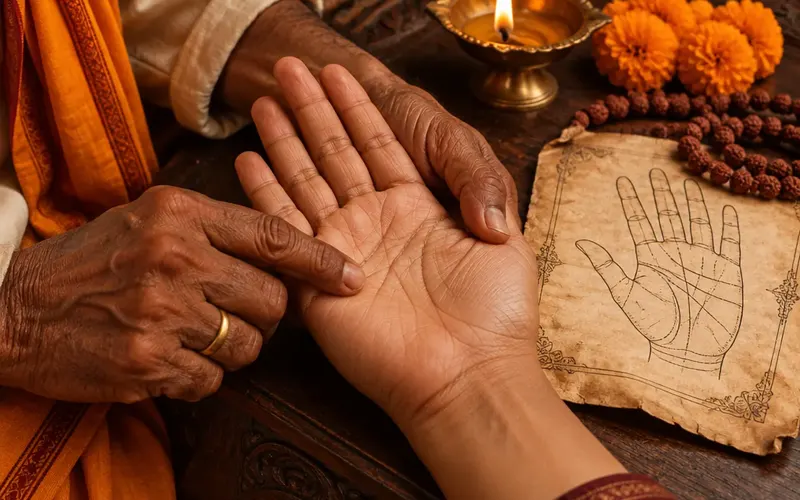
A sharp, well-lit photo shows nearly everything a reader looks at first:
- The major lines: life, head, heart and fate, including where they start and end, and any breaks.
- The mounts: the raised pads of the palm, which appear in side light. See the seven mounts for what each is said to govern.
- Hand shape and finger proportion: the broad build of the hand, the length of the fingers and how they relate.
- Marks: crosses, stars and islands, as long as the image is sharp enough to show them.
What does a photo miss?
A camera only gives a flat, surface view. A reader working from photos loses a few things:
- Texture and firmness. Traditional readers feel whether the hand is soft or firm, and how far the thumb and fingers bend.
- True colour. Phone cameras adjust colour, and indoor lighting can change it further.
- Depth. Without careful lighting, mounts look flatter and fine lines disappear.
- Follow-up inspection. In the room, a reader can turn your hand toward the window. By phone, they have to ask you for another photo.
None of this makes a photo reading worthless, but a reader who says a photo loses nothing is overselling. A reasonable reader also tells you when a picture is too poor to read and asks for another.
How should you take palm photos?
A little care makes a big difference, and it takes only a couple of minutes:
- Use daylight. Stand near a window, with no direct sun on the hand. Turn the flash off, since it flattens the lines.
- Photograph both hands. Take each one separately, as the tradition reads them together. Note which is your dominant hand.
- Open the hand naturally. Keep your fingers together but relaxed, and do not stretch them hard, which pulls the fine lines flat.
- Fill the frame. Include the whole palm, the fingers and the wrist crease. Have someone else take the picture if you can.
- Add a side view. One shot from a low angle shows the mounts, and one of the back of the hand shows its overall shape.
- Check the focus. Zoom in before you send. If you cannot make out the smaller lines, neither can the reader.
Also consider what else is in the picture. Remove rings if you are comfortable doing so, and crop out anything private in the background.
Why does he also ask for your birth details?
Because in this tradition a hand is rarely read on its own. Vijay Ram ji treats palmistry, or samudrika shastra, as a second view of the same person. Your birth chart is calculated from your date, time and place of birth, whereas a hand has to be interpreted. So where the two agree, the reading is firmer. Where they disagree, the chart leads. Reading the two together covers this in more detail.
If you do not know your exact birth time, say so. Palmistry can still help, and a reader who works honestly will tell you which conclusions become less certain without it.
How does a remote palm reading work?
With Vijay Ram ji, it begins with a free conversation about what you want to understand. Once any fee is agreed, you send the photos and your birth details by WhatsApp, and the reading takes place by phone or video so that you can ask questions as he goes. A remote session costs the same as an in-person one at Warden Avenue. If you are in the GTA and would like him to see your hand directly, the palm reader near me page explains how to do that.
When should you see a reader in person instead?
In-person reading makes sense when your photos keep coming out unclear, when your palm has scars or skin conditions that confuse the picture, or simply when you would rather talk face to face. Whichever you choose, the limits stay the same. A palm does not name events or dates, and it is not a medical test. If you are picking someone new, read how to find a palm reader you can trust first.
Frequently asked questions
Is a palm reading from a photo as good as in person?
It covers most of the same ground if the photos are clear, but it loses texture and flexibility. Many people find it good enough, and an honest reader will tell you if a picture is too poor to use.
Which hand should I photograph for a palm reading?
Both, separately. The tradition distinguishes what you were born with from what you have made of it, so tell the reader which hand is dominant.
Is it safe to send a photo of my palm?
Send it only to someone you have chosen and checked. Crop out documents and anything private, and never send ID or bank details along with a reading request.
Can a palm be read without a birth time?
Yes. A palm reading does not rely on birth time, although the chart side of the reading will be less certain without it. Say so at the start.
Can palm reading apps read a photo?
Some claim to. An app can produce general text, but it cannot ask you for a better picture, discuss your situation or check against your chart.
References & further reading
Serving Scarborough and the Greater Toronto Area
In person at 1540 Warden Ave., or by phone, video & WhatsApp — including: