Part of our guides on vastu and home.
Quick answer
In Vastu Shastra, the north and east are the most auspicious directions for a main door because they invite light, positive energy, and prosperity. A south-facing entrance is considered challenging but can be remedied with specific vastu corrections. A qualified consultant can assess your home's unique orientation and suggest practical solutions.
Vastu Shastra is an ancient Indian architectural science that aligns a building's layout, orientation, and energy flow with the five natural elements — earth, water, fire, air, and space — to support the well-being and prosperity of its occupants. Among all the guidelines Vastu Shastra offers, the direction of the main entrance is considered one of the most significant, because it is the point through which energy — both physical and subtle — first enters the home. For families across Scarborough, Markham, and the wider Greater Toronto Area who are building, buying, or renovating, understanding main door direction vastu can be the difference between a thriving household and one that feels persistently unsettled.
Which Direction Is Best for a Main Door According to Vastu?
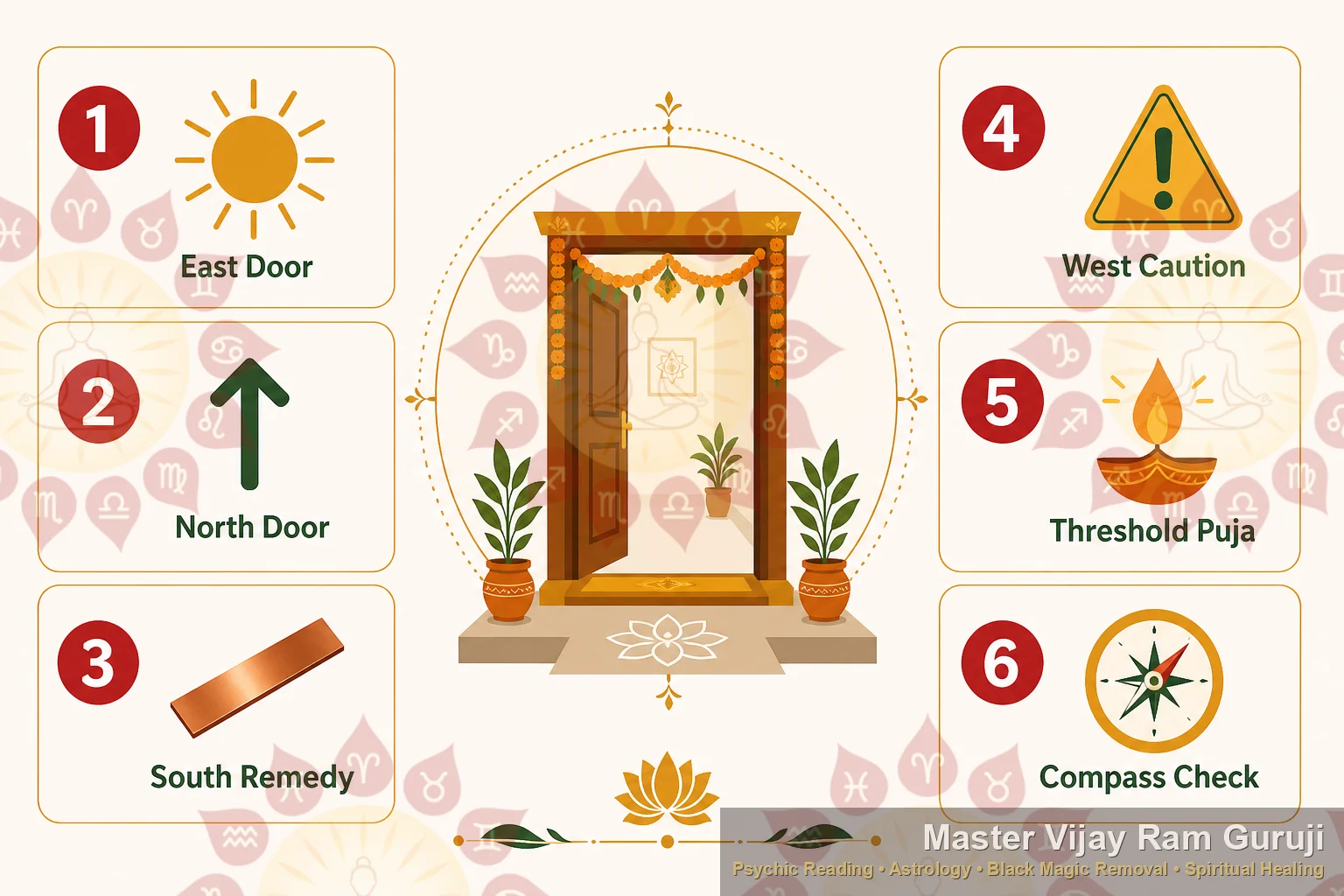
The north and east directions are widely regarded as the most favourable orientations for a main entrance in Vastu Shastra. East aligns the home with the rising sun, symbolising new beginnings, vitality, and clarity of mind. North is governed by Kubera, the deity of wealth, and is associated with the flow of prosperity and opportunity into the household.
The northeast corner — the Ishan zone — is considered the most sacred quadrant of any property. A door positioned in the northeast or leaning toward it in either the north or east walls is traditionally viewed as highly auspicious. Many vastu practitioners, including Master Vijay Ram Guruji at his Scarborough consultation centre, begin every home assessment by mapping the entrance against the cardinal directions using a compass before evaluating any other aspect of the floor plan.
What About East-Facing vs. North-Facing Entrances?
Both east and north entrances carry strong positive associations, but they differ in emphasis. An east-facing door is especially recommended for homes where health, reputation, and children's education are priorities. A north-facing door is favoured where financial growth and career advancement are the primary goals.
- East entrance: sunlight enters early; supports health, clarity, and social standing.
- North entrance: linked to prosperity; ideal for business owners and professionals.
- Northeast entrance: combines both benefits; considered the most auspicious of all positions.
- West entrance: generally neutral; can support stability when properly proportioned.
- South entrance: traditionally considered challenging; specific remedies are recommended.
- Southwest entrance: the most cautioned position; often associated with instability if left uncorrected.
If your home's career or financial prospects feel blocked, a review of your home's vastu alongside business and career guidance can reveal whether your entrance direction is contributing to the pattern.
Is a South-Facing Main Door Really Harmful?
This is one of the most common concerns raised by homeowners in the Greater Toronto Area, where housing stock often dictates orientation rather than personal choice. The short answer is: a south-facing entrance is not a guaranteed source of misfortune, but it does require deliberate vastu corrections to function harmoniously.
In classical texts, the south is governed by Yama, the deity of endings, which is why an uncorrected south entrance is associated with conflict, financial drain, or health challenges in certain households. However, Vastu Shastra is a corrective science, and most south-facing entrance concerns can be addressed without structural changes.
What Are the Main South-Facing Door Remedies?
- Copper strip threshold: Embedding a copper strip across the door sill is one of the most cited vastu remedies for a south-facing entrance, as copper is believed to deflect disruptive energy.
- Vastu pyramids or yantra: Placing a Sri Yantra or vastu pyramid above the door frame redirects energy flow.
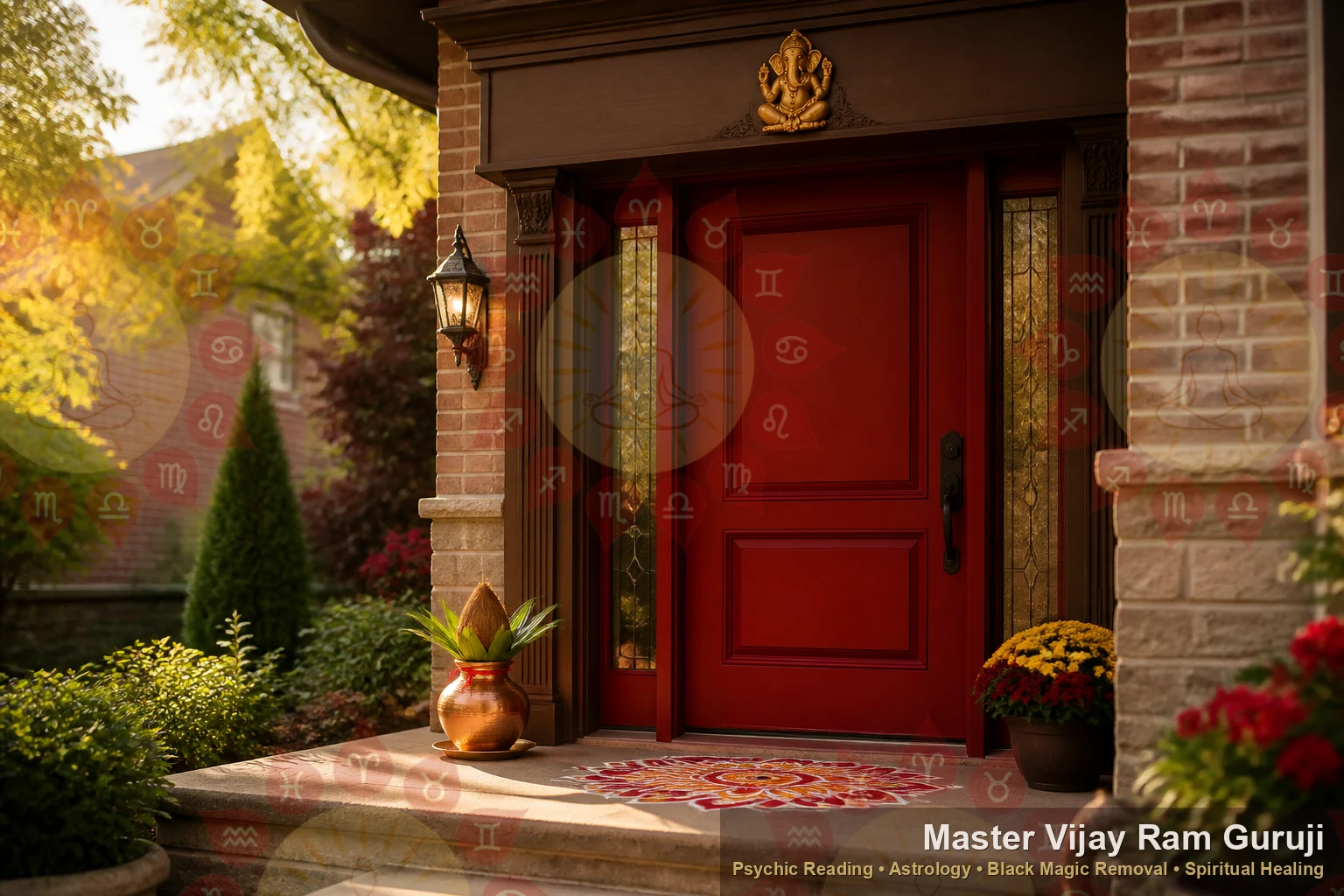
- Specific door colour: Deep red, silver, or white tones on a south-facing door are traditionally preferred over dark or black shades.
- Threshold puja: A ritual consecration of the entrance using specific mantras, kumkum, and a diya (oil lamp) re-establishes the threshold's protective quality.
- Navagraha lamp: Keeping a consistently lit lamp near the entrance counterbalances the directional energy.
- Avoid mirrors facing the door: A mirror directly opposite a south entrance is said to reflect negative energy back into the home — removing it is a simple but effective correction.
Each remedy works best when selected for the specific home layout, the residents' birth charts, and the precise sub-direction of the door. For a tailored assessment, homeowners across Scarborough and the GTA are welcome to reach out to arrange a vastu consultation in person, by phone, or by video — sessions are available in English, Tamil, Hindi, Punjabi, Gujarati, and Urdu.
How Does Vastu Interact With Your Personal Astrology?
Vastu and Vedic astrology are complementary disciplines. The ideal entrance direction for a property is often cross-referenced against the owner's rashi (moon sign) and the lagna (rising sign) in their birth chart. A north-facing door may be generically auspicious, yet a person whose chart shows a weakened Mercury — the planet of commerce — might receive greater benefit from an east-facing entrance aligned with the Sun.
Master Vijay Ram Guruji integrates a detailed review of the resident's Vedic birth chart into every vastu consultation to ensure that entrance direction advice is personalised rather than generic. This integrated approach reflects the traditional understanding that a building and its occupants form a single energetic system.
What Signs Suggest Your Main Door Direction May Need Attention?
- Persistent financial strain that began after moving into the property.
- Frequent arguments or tension among family members near the entrance.
- Difficulty with career advancement despite clear qualifications.
- Guests or visitors often feel uneasy entering the home.
- Recurring minor accidents or illnesses in the household — always consult a doctor for health concerns; vastu is not a medical treatment.
- A general feeling of heaviness or lack of warmth in the front area of the home.
These experiences alone do not confirm a vastu imbalance, and many factors — personal, financial, and social — shape a family's circumstances. A structured vastu assessment helps separate architectural influences from other causes. You may also wish to explore whether numerological guidance alongside gemstone recommendations can further support the home's energy profile.
Can Master Vijay Ram Guruji Help With Vastu for Rented or Condo Homes?
Yes. Many residents of Scarborough and the Greater Toronto Area live in condominiums, townhouses, or rental units where structural changes are not possible. In these situations, vastu guidance focuses entirely on non-invasive corrections — placement of objects, colours, lighting, plants, and simple rituals — that can be applied without modifying the building itself.
Consultations take place at 1540 Warden Ave., Scarborough, ON M1R 2S8, or remotely at (647) 640-9586, 24 hours a day. For a comprehensive look at what a full property assessment covers, visit the detailed overview of vastu consultation services offered at the practice.
Frequently asked questions
Which direction is best for a main door in vastu shastra?
North and east are the most auspicious directions for a main entrance according to Vastu Shastra. The northeast corner combines both benefits and is considered the most favourable position. East aligns the home with sunlight and vitality, while north is associated with the flow of wealth and opportunity.
Is a south-facing main door really bad in vastu?
A south-facing door is considered challenging in classical Vastu Shastra but is not automatically harmful. Targeted remedies — such as a copper strip threshold, specific paint colours, and a threshold puja — are well-established corrections that significantly mitigate the concern without requiring structural changes.
What is the simplest vastu remedy for a south-facing entrance?
Embedding a copper strip across the door's threshold is one of the most widely recommended non-structural remedies for a south-facing entrance. Pairing it with a continuously lit oil lamp near the door and removing any mirror that directly faces the entrance are additional low-cost corrective steps.
Does vastu for main entrance apply to apartments and condos?
Yes. Vastu guidance for condominiums and rental units focuses on non-invasive adjustments — placement of objects, colours, lighting, and simple rituals — rather than structural changes. Many effective corrections require no modifications to the building's fabric at all.
How does my birth chart affect the best door direction for my home?
In the integrated approach practised by Master Vijay Ram Guruji, your rashi (moon sign) and lagna (rising sign) are cross-referenced with the property's orientation. What is generically auspicious may be further strengthened — or subtly adjusted — when matched to the specific planetary strengths in your Vedic chart.
Can I get a vastu consultation for my Scarborough or GTA home remotely?
Yes. Master Vijay Ram Guruji offers vastu consultations in person at 1540 Warden Ave., Scarborough, as well as by phone, video, and WhatsApp at (647) 640-9586, 24 hours a day, in English, Tamil, Hindi, Punjabi, Gujarati, and Urdu.
Does vastu shastra conflict with modern architectural design?
Vastu principles are architectural guidelines, not rigid rules that override structural requirements. Many contemporary architects in India and Canada incorporate vastu orientation into new builds. Where the existing structure cannot be changed, vastu corrections focus on interior placement, colour, and ritual — all compatible with modern design aesthetics.
People also ask
What happens if the main door faces southwest in vastu?
A southwest-facing entrance is considered the most cautioned position in Vastu Shastra, associated with instability and the erosion of accumulated wealth. Vastu practitioners typically recommend a combination of copper remedies, specific thresholds, and a ritual consecration of the entrance to reduce this directional imbalance.
Which colour is best for a south-facing main door?
Deep red, silver, or bright white are traditionally recommended for south-facing doors in vastu. These tones are considered to counterbalance the directional energy associated with the south. Dark, brown, or black colours are generally avoided on south-facing entrances.
Does vastu shastra have scientific backing?
Vastu Shastra is a traditional Indian architectural system rooted in ancient Sanskrit texts. Some of its principles — such as maximising natural light from the east and ensuring cross-ventilation — align with modern environmental design thinking. It is a cultural and spiritual practice, and its benefits are understood within that framework.
Can vastu corrections improve financial problems?
Vastu Shastra is a traditional guidance practice that aims to create harmonious living conditions. While many families report positive changes after corrections, vastu is not a guaranteed financial solution. It is best understood as one supportive layer alongside practical financial planning and, where relevant, Vedic astrology guidance.
Is an east-facing house always better than a north-facing one?
Both east-facing and north-facing homes are considered auspicious in Vastu Shastra, but neither is universally superior. The better orientation depends on the residents' goals, their birth chart placements, and the full layout of the property. A personalised assessment yields more reliable guidance than a general ranking.
References & further reading
Keep exploring
Serving Scarborough and the Greater Toronto Area
In person at 1540 Warden Ave., or by phone, video & WhatsApp — including: