Part of our guides on vastu and home.
Quick answer
Vastu Shastra is an ancient Indian architectural science rooted in Vedic texts, aligning spaces with five elements and cardinal directions. Feng Shui is a Chinese practice that balances Qi energy using the bagua map. Both improve living spaces, but they differ in origin, methodology, and remedies.
Vastu Shastra is a Vedic science of spatial arrangement that aligns built environments with natural forces, cardinal directions, and the five classical elements to support wellbeing and prosperity. When clients ask Master Vijay Ram Guruji at his Scarborough consultation centre about the difference between Vastu and Feng Shui, the answer begins here: though both traditions seek harmony between people and their spaces, they emerge from completely separate civilisations, texts, and philosophies.
What Are the Origins of Vastu and Feng Shui?
Vastu Shastra is documented in ancient Sanskrit texts, including the Manasara and the Brihat Samhita, making it one of the oldest recorded systems of architectural science in the world. It is interwoven with Vedic cosmology and forms part of the same knowledge tradition as Jyotish (Vedic astrology).
Feng Shui (風水) developed in ancient China and is rooted in Taoist philosophy. Its name translates literally as "wind-water," and its earliest written references appear in texts dating back several centuries BCE. The two systems evolved independently, on different continents, without cross-influence in their classical forms.
How Do the Core Principles Differ?
Vastu Shastra is built around Pancha Bhuta — the five Vedic elements of Earth (Prithvi), Water (Jal), Fire (Agni), Air (Vayu), and Space (Akasha). Every room, door, and window placement is guided by these elements in relationship to the eight cardinal and intercardinal directions.
Feng Shui works with a different set of five elements — Wood, Fire, Earth, Metal, and Water — and centres on the flow of Qi (life energy) through a space. Practitioners use the bagua map, a grid overlaid onto a floor plan, to diagnose energy imbalances.
The most practical distinction: Vastu treats the compass bearing of each room as non-negotiable, while Feng Shui allows more flexibility through symbolic and energetic corrections.
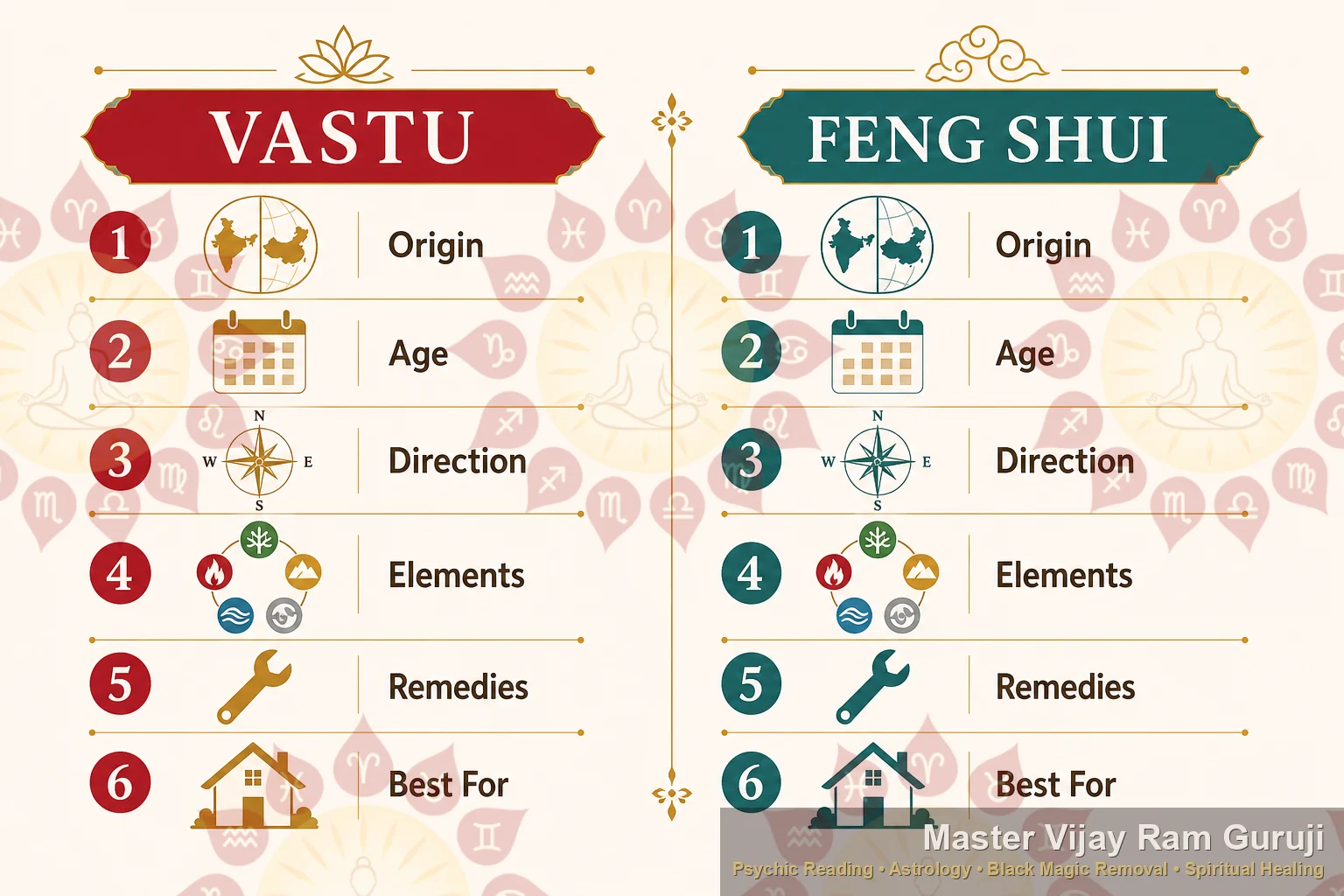
What Are the Key Differences at a Glance?
| Feature | Vastu Shastra | Feng Shui |
|---|---|---|
| Origin | India (Vedic tradition) | China (Taoist tradition) |
| Core concept | Pancha Bhuta + directions | Qi energy + bagua |
| Primary tool | Vastu Purusha Mandala, compass | Bagua map, lo pan compass |
| Five elements | Earth, Water, Fire, Air, Space | Wood, Fire, Earth, Metal, Water |
| Remedies | Structural changes, yantras, Vedic rituals | Symbolic objects, colours, mirrors |
| Texts | Manasara, Brihat Samhita | Zangshushu, Qingwujing |
Which Is Better — Vastu or Feng Shui?
Neither system is objectively superior. The more meaningful question is: which is better for you? Cultural context, personal belief, and the specific issue you want to address all matter.
For families of South Asian heritage, or for those whose homes and businesses are being assessed alongside a Vedic birth chart reading to understand planetary influences on your space, Vastu Shastra is the internally consistent choice — its directional guidelines and elemental logic form part of the same cosmological system as Jyotish.
Feng Shui may resonate more naturally with those from East Asian cultural backgrounds or those already familiar with Taoist concepts. Many practitioners in North America blend elements of both, though purists in either tradition caution against mixing the two.
What Are the Signs That Your Space May Need a Vastu Assessment?
- Persistent unexplained arguments or tension at home
- Difficulty sleeping or chronic fatigue with no medical cause
- Financial setbacks that seem to follow you from address to address
- Stagnation in career or business despite consistent effort
- A feeling of heaviness or discomfort in specific rooms
- Recurring ill health in a particular family member (always consult a doctor first — Vastu does not replace medical care)
- New home or office feeling "off" without a clear reason
How Does a Vastu Consultation with Master Vijay Ram Guruji Work?
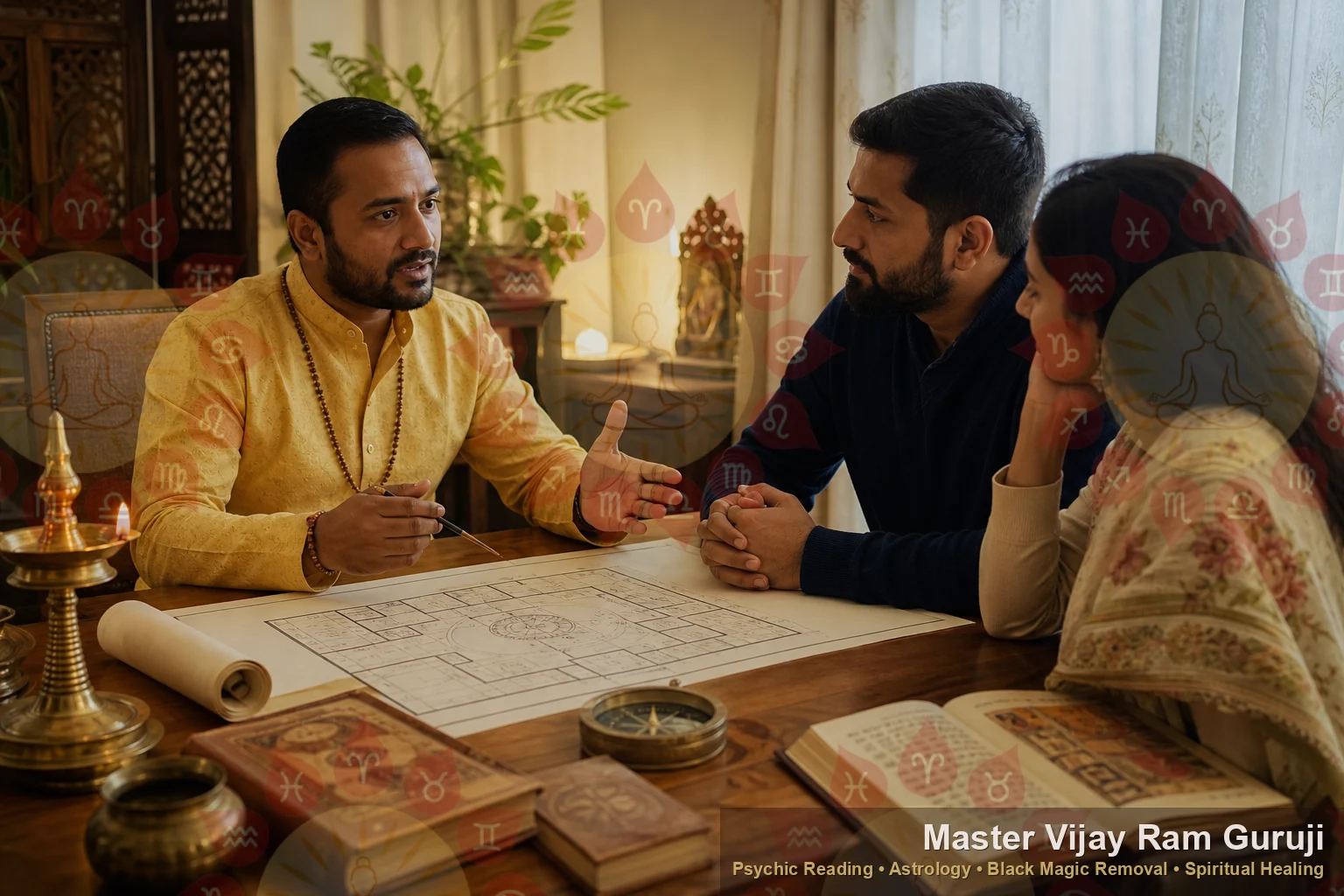
- Floor plan review: You share your home or office layout — photos, a hand-drawn sketch, or architect plans all work.
- Directional analysis: Each zone is mapped against the Vastu Purusha Mandala and cardinal compass directions.
- Elemental assessment: Placement of kitchen, bedroom, entry, and water features is evaluated against Pancha Bhuta principles.
- Remedies proposed: Corrections are suggested — these may include room-use changes, placement of Vedic yantras, colour guidance, or minor structural adjustments where feasible.
- Integration with your chart: Where relevant, Vastu findings are considered alongside your Vedic birth chart, because planetary placements can intensify or soften directional imbalances.
Consultations take place in person at 1540 Warden Ave., Scarborough, ON M1R 2S8, or remotely by phone, video, or WhatsApp — available 24 hours a day to clients across the Greater Toronto Area, including Markham, Vaughan, and beyond. Sessions are offered in English, Tamil, Hindi, Punjabi, Gujarati, and Urdu.
Can Vastu and Feng Shui Be Combined?
This is one of the most common questions for clients in the Greater Toronto Area, where multicultural households sometimes draw on both traditions. Strictly speaking, the two systems use different directional grids, element sets, and remedial logic, so combining them without expertise can create contradictions rather than clarity.
An honest limitation worth stating: no Vastu or Feng Shui practitioner can guarantee a specific outcome. Both traditions offer a framework for understanding how spatial design may influence wellbeing — they are not mechanical switches. Results depend on many factors, including the broader planetary period indicated by your Vedic chart, for which a detailed space-energy review aligned with Vedic principles offers the most coherent starting point.
How Does Vastu Connect to Other Vedic Guidance?
Vastu Shastra sits within a broader ecosystem of Vedic knowledge. A home facing south-west challenges may be compounded by a weak Saturn in the natal chart; a business struggling in a north-facing space may align with Mercury difficulties. This is why reviewing career and business momentum through a Vedic lens often accompanies a Vastu consultation for entrepreneurs and professionals in Scarborough.
Similarly, gemstone and numerology guidance chosen to complement your personal energy can work alongside Vastu remedies for a more complete approach to balancing your environment and your individual planetary influences.
How Do I Book a Vastu Consultation in Scarborough or the GTA?
Reach Master Vijay Ram Guruji at (647) 640-9586 or visit the consultation booking page to arrange your Vastu assessment. Whether you are moving into a new home, launching a business, or simply feeling that something in your current space is not quite right, a Vastu review grounded in authentic Vedic tradition is a thoughtful first step.
Frequently asked questions
What is the main difference between Vastu and Feng Shui?
Vastu Shastra is a Vedic Indian system that aligns spaces with five classical elements and strict cardinal directions. Feng Shui is a Chinese Taoist practice that works with Qi energy and the bagua map. They share a goal — harmonious spaces — but use entirely different cosmological frameworks and remedies.
Which is better, Vastu or Feng Shui, for a South Asian household?
Vastu Shastra is generally more contextually consistent for South Asian households because it shares the same Vedic cosmological foundation as Jyotish astrology and Hindu ritual practice. It uses directional and elemental principles drawn from Sanskrit texts specifically designed for the built environments of that tradition.
Can I use Vastu and Feng Shui together?
Combining them is possible but requires care. The two systems use different element sets and directional grids, so applying both without specialist knowledge can create contradictions. A practitioner trained in one system deeply is usually preferable to a superficial mix of both.
Does Vastu require structural changes to my home?
Not always. While classical Vastu ideally informs construction from the ground up, many practical remedies involve changes to room usage, placement of yantras, colour selection, and furniture arrangement. A skilled consultant will propose solutions that respect your existing structure wherever possible.
How old is Vastu Shastra compared to Feng Shui?
Both traditions are ancient. Vastu Shastra is documented in Sanskrit texts such as the Manasara and Brihat Samhita, with origins traced to the Vedic period. Feng Shui's earliest written references appear in Chinese texts from several centuries BCE. Precise comparative dating is debated by scholars.
Is there scientific proof that Vastu or Feng Shui works?
Neither system has been validated by controlled scientific studies in the Western academic sense. Both are traditional frameworks offering guidance on spatial design and its relationship to wellbeing. They are best understood as culturally grounded wisdom practices, not medical or engineering sciences.
Can Master Vijay Ram Guruji do a Vastu consultation remotely for clients outside Scarborough?
Yes. Remote consultations are available by phone, video call, or WhatsApp, 24 hours a day, to clients across the Greater Toronto Area and beyond. You can share floor plans and photos digitally, making a full Vastu assessment possible without an in-person visit.
How does Vastu connect to Vedic astrology?
Vastu and Jyotish (Vedic astrology) share the same cosmological roots. Planetary placements in your birth chart can intensify directional challenges in your home, so many practitioners assess both together. For example, a challenging Saturn placement may compound a problematic south-west entrance.
People also ask
What are the five elements in Vastu Shastra?
The five elements in Vastu Shastra are Earth (Prithvi), Water (Jal), Fire (Agni), Air (Vayu), and Space (Akasha) — collectively called Pancha Bhuta. Each element governs specific directions and zones within a home or building, forming the foundation of Vastu's directional analysis.
What does Feng Shui mean literally?
Feng Shui (風水) is a Chinese term that translates literally as 'wind-water.' It reflects the Taoist idea that invisible energy flows — like wind and water — move through landscapes and built environments, and that aligning with these flows supports health, prosperity, and harmony.
Is Vastu Shastra part of Vedic astrology?
Vastu Shastra is not astrology itself, but it belongs to the same Vedic knowledge system. It is classified as an Upaveda (supplementary Vedic science) and shares cosmological principles with Jyotish. Many Vedic astrologers incorporate Vastu analysis alongside birth chart readings.
What direction should the main door face according to Vastu?
North, north-east, and east-facing main doors are generally considered auspicious in Vastu Shastra, as these directions are associated with positive energy flow. However, ideal direction can vary based on the owner's birth chart and the specific purpose of the building.
Are Vastu consultations available in Toronto and the GTA?
Yes. Master Vijay Ram Guruji offers Vastu consultations from his centre at 1540 Warden Ave., Scarborough, Ontario, and remotely by phone, video, or WhatsApp for clients across the Greater Toronto Area, including Markham, Pickering, Richmond Hill, and Vaughan.
References & further reading
Keep exploring
Serving Scarborough and the Greater Toronto Area
In person at 1540 Warden Ave., or by phone, video & WhatsApp — including: