
Part of our guides on evil eye and nazar.
Quick answer
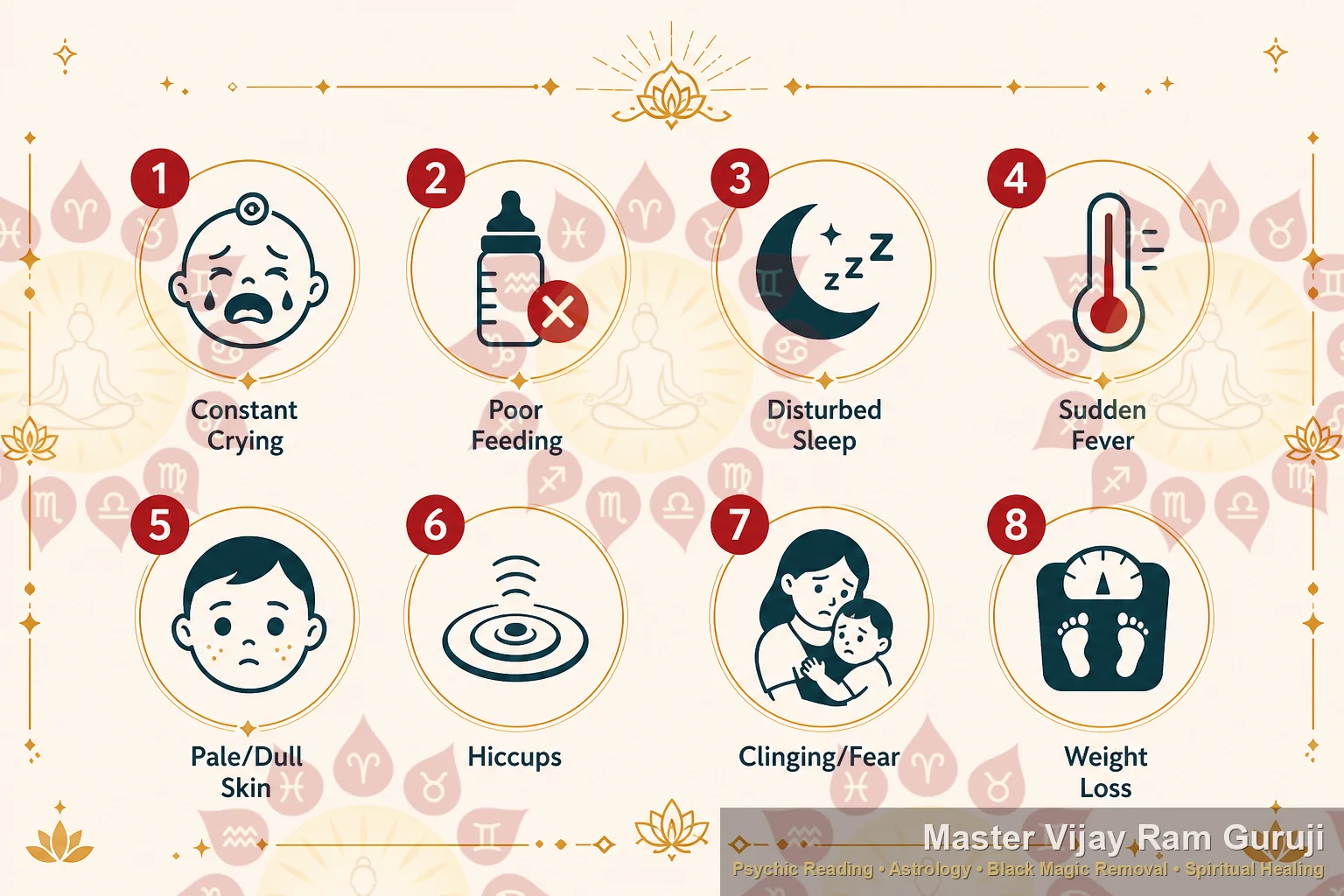
Signs of nazar in babies include persistent unexplained crying, sudden fever, poor feeding, disturbed sleep, hiccups, pale skin, and unusual clinginess — especially after being admired by visitors. These symptoms appear without a clear medical cause and are traditionally linked to the evil eye, or nazar, in many South Asian, Middle Eastern and Mediterranean cultures.
Nazar is a traditional belief, found across South Asian, Middle Eastern, Mediterranean and Latin American cultures, that describes the inadvertent transfer of harmful energy through an intensely admiring or envious gaze — and infants and young children are considered the most vulnerable recipients. Families in Scarborough and across the Greater Toronto Area frequently seek guidance when a baby develops unexplained symptoms shortly after a gathering or visit from guests. This article explains what those signs look like, why they are believed to occur, and what traditional remedies exist.
Why Are Babies and Toddlers So Vulnerable to Nazar?
Traditional teachings across multiple cultures hold that a young child's aura, or subtle energy field, is not yet fully formed, making it far more permeable to outside influences than an adult's. A newborn draws enormous admiration — sometimes from many people at once — and it is this concentrated, unguarded attention that is believed to create an imbalance.
The risk is considered highest in the first forty days of a child's life, a period many cultures deliberately protect through limited visitor access and the use of protective amulets. Even well-meaning praise — "what a beautiful baby!" — is traditionally thought to carry nazar if it is expressed with strong emotion and no protective blessing such as mashallah or nazar na lage.

What Are the Classic Signs of Nazar in a Baby?
Families who hold this belief often describe signs appearing soon after a child has been in a social situation or admired by visitors. The symptoms are typically sudden in onset and have no obvious physical explanation. A paediatrician should always be consulted for persistent symptoms — spiritual assessment does not replace medical care.
- Persistent, inconsolable crying that does not respond to feeding, holding or rocking
- Sudden refusal to feed — breastfed or bottle-fed babies who normally feed well abruptly stop
- Frequent, unexplained hiccuping or yawning bouts, particularly soon after contact with visitors
- Disturbed or very light sleep — the child startles awake repeatedly and seems unable to settle
- Pale, dull, or slightly yellowish skin tone appearing without a diagnosed medical cause
- Low-grade fever that rises and falls without infection markers — always verify with a doctor first
- Unusual clinginess or fearfulness, as though the child senses something unsettling
- Unexplained weight loss or failure to gain weight over a short period
- Glassy or dull eyes and general lethargy in a baby who was previously alert and active
How Does Baby Nazar Lagna Differ from Illness?
The key distinguishing factor families describe is timing: baby nazar lagna typically occurs within 24–48 hours of a specific social event — a naming ceremony, a family gathering, or a visit from neighbours. A child who was perfectly settled becomes fussy and unwell almost overnight. In contrast, a common infection tends to develop more gradually and is accompanied by other clear signs such as a runny nose, vomiting, or measurable high fever.
It is both reasonable and important to have the child examined by a paediatrician first. Once medical causes have been ruled out and the timing pattern strongly suggests nazar, many families then turn to a trusted spiritual practitioner. For families in Scarborough and across the Greater Toronto Area, a practitioner experienced in identifying and clearing nazar for children and adults alike can assess the situation and recommend appropriate remedies.
What Traditional Remedies Are Used for Nazar in Children?
Traditional cultures have developed a wide range of remedies, many of which are low-risk protective rituals performed at home. The most widely practised include:
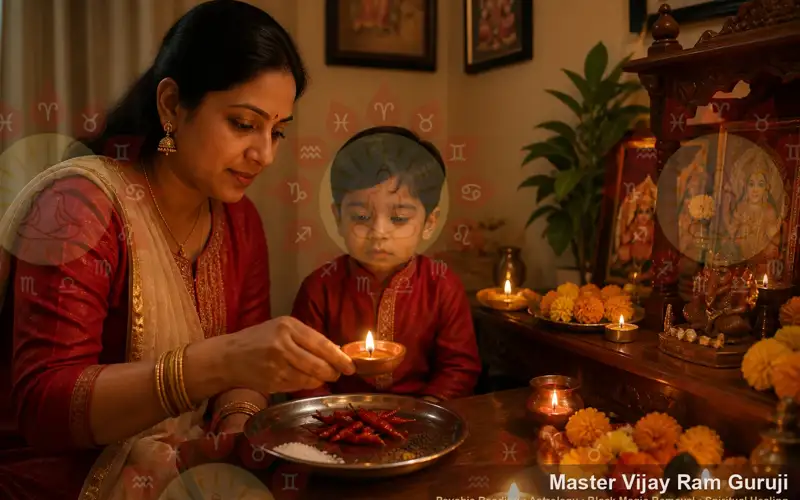
- Nazar utarna with salt and chilli: A handful of rock salt and two dried red chillies are circled around the child's head seven times, then thrown onto a flame. A crackling sound or the chillies burning without a harsh smell is interpreted as confirmation that nazar was present.
- Mustard-seed smoke (rai utarna): Mustard seeds are similarly circled and cast into fire, creating a brief protective smoke.
- Application of kajal (kohl): A small dot placed behind the ear or on the sole of the foot is a common preventative measure in many South Asian households.
- Protective amulets: A black nazarbattu bead, a blue glass evil-eye charm, or a personally prepared kavach or protective talisman crafted for the child can be pinned to clothing or hung above the crib.
- Recitation of protective prayers: Verses from religious scripture — whether Quranic ayat, Vedic mantras, or other sacred texts — are recited over the child by an elder or spiritual guide.
For situations where home remedies have not brought relief, or where the child has been affected repeatedly, a deeper assessment of accumulated negative energy that may be affecting the family environment may be warranted.
How Can Parents Protect a Newborn from Nazar Going Forward?
Protecting a newborn from nazar is considered an ongoing practice rather than a one-time event. Simple daily habits can significantly reduce a child's exposure:
- Limit the number of new visitors in the first weeks of life.
- Ask guests to say a protective blessing aloud when admiring the baby.
- Keep a protective charm pinned to the child's clothing when going outdoors.
- Perform a brief nazar utarna ritual after busy social events such as weddings or large family gatherings.
- Arrange periodic aura cleansing for the child and the home environment to keep the energy around the family clear and balanced.
When Should You Seek Guidance from a Spiritual Practitioner?
If home remedies bring only temporary relief, if the symptoms recur frequently, or if multiple children in the same household are affected, it is advisable to seek a proper spiritual consultation. Master Vijay Ram Guruji sees families in person at his centre at 1540 Warden Ave., Scarborough, ON, and also offers consultations by phone, video call and WhatsApp — available around the clock — in English, Tamil, Hindi, Punjabi, Gujarati and Urdu, making it accessible for families throughout Markham, Richmond Hill, Pickering, Ajax, and the broader Greater Toronto Area.
To arrange a session at a time that suits your family, you are welcome to reach out directly to book a consultation at the Scarborough centre or online. Guidance is always offered with care and without pressure — the goal is simply to support your child's wellbeing and restore calm to your household.
Frequently asked questions
What are the most common evil eye symptoms in babies?
The most commonly reported symptoms include sudden inconsolable crying, refusal to feed, frequent unexplained hiccuping, restless sleep, pale or dull skin, and a low-grade fever — typically appearing within 24–48 hours of the baby being admired at a gathering or by visitors.
How do I know if my baby has nazar or is just unwell?
In this belief, families point to timing: symptoms that come on soon after a social event. A sudden change in a baby needs a doctor first. Always see a paediatrician first to rule out infection or illness. If medical causes are excluded and the timing pattern persists, a spiritual assessment can help determine whether nazar is a factor.
What is nazar utarna and how is it done for a baby?
Nazar utarna is a traditional cleansing ritual in which rock salt and red chillies (or mustard seeds) are circled around the child's head seven times and then cast into a flame. The ritual is believed to absorb and neutralise the negative energy of the evil eye and is safe to perform at home.
Is it safe to put kajal on a baby to prevent nazar?
Many families apply a small kajal dot behind the baby's ear or on the foot rather than near the eyes. If you are considering applying it anywhere near the eyes, consult your paediatrician first, as commercial kajal products can contain substances not suitable for infants' eyes.
Can nazar affect older toddlers and children, not just newborns?
Yes. While newborns are considered most vulnerable, toddlers and school-age children can also be affected, particularly after periods of heightened attention such as starting school, performing in public, or receiving a lot of praise. The same signs — mood changes, appetite loss, disturbed sleep — can apply.
Where can I get nazar removal help for my child in Scarborough or the GTA?
Master Vijay Ram Guruji provides nazar assessment and removal at 1540 Warden Ave., Scarborough, ON. Remote consultations by phone, video call or WhatsApp are also available around the clock, serving families throughout the Greater Toronto Area including Markham, Richmond Hill, Pickering and Vaughan.
How long does it take to see improvement after nazar removal for a child?
No result or timeline can be promised. If a child is not feeding or sleeping, or seems unwell, see a doctor the same day and don't wait for a ritual to work. Results vary depending on how long the nazar has been present and the child's overall energy balance. No specific outcome can be guaranteed.
Do I need to bring my child in person, or can the consultation be done remotely?
Both options are available. In-person sessions are held at 1540 Warden Ave., Scarborough. Remote consultations by phone, video call or WhatsApp are equally effective for assessment and guidance, making the service accessible for families anywhere in the Greater Toronto Area or beyond.
People also ask
Why do babies get nazar more easily than adults?
Traditional belief holds that an infant's aura or subtle energy field is undeveloped and unguarded, making it far more susceptible to the concentrated emotional energy of admiration or envy. This is why many cultures restrict newborn visitors and apply protective charms as a matter of routine.
What does a baby with nazar look like?
A baby affected by nazar may appear dull-eyed, unusually pale, lethargic, or persistently tearful. They may refuse feeds they normally enjoy, hiccup frequently without cause, and be unable to sleep despite being tired — all without any physical illness identified by a doctor.
Can nazar cause a baby to lose weight?
Prolonged nazar is traditionally associated with feeding difficulties and general listlessness, which can result in poor weight gain. Any unexplained weight loss in an infant must be evaluated promptly by a paediatrician regardless of suspected spiritual causes.
Is the evil eye belief found only in South Asian culture?
No. Belief in the evil eye appears across South Asian, Middle Eastern, Mediterranean, Latin American and East African cultures. It is documented in ancient Greek, Roman, and Islamic texts and remains a living tradition in many communities worldwide today.
What protective charm is best for a newborn against nazar?
Common protective items include a black nazarbattu bead, a blue glass evil-eye charm, or a personalised kavach prepared by a spiritual practitioner. Many families use a combination of a physical charm and periodic cleansing rituals for ongoing protection.
References & further reading
Keep exploring
Serving Scarborough and the Greater Toronto Area
In person at 1540 Warden Ave., or by phone, video & WhatsApp — including: