Part of our guides on evil eye and nazar.
Quick answer
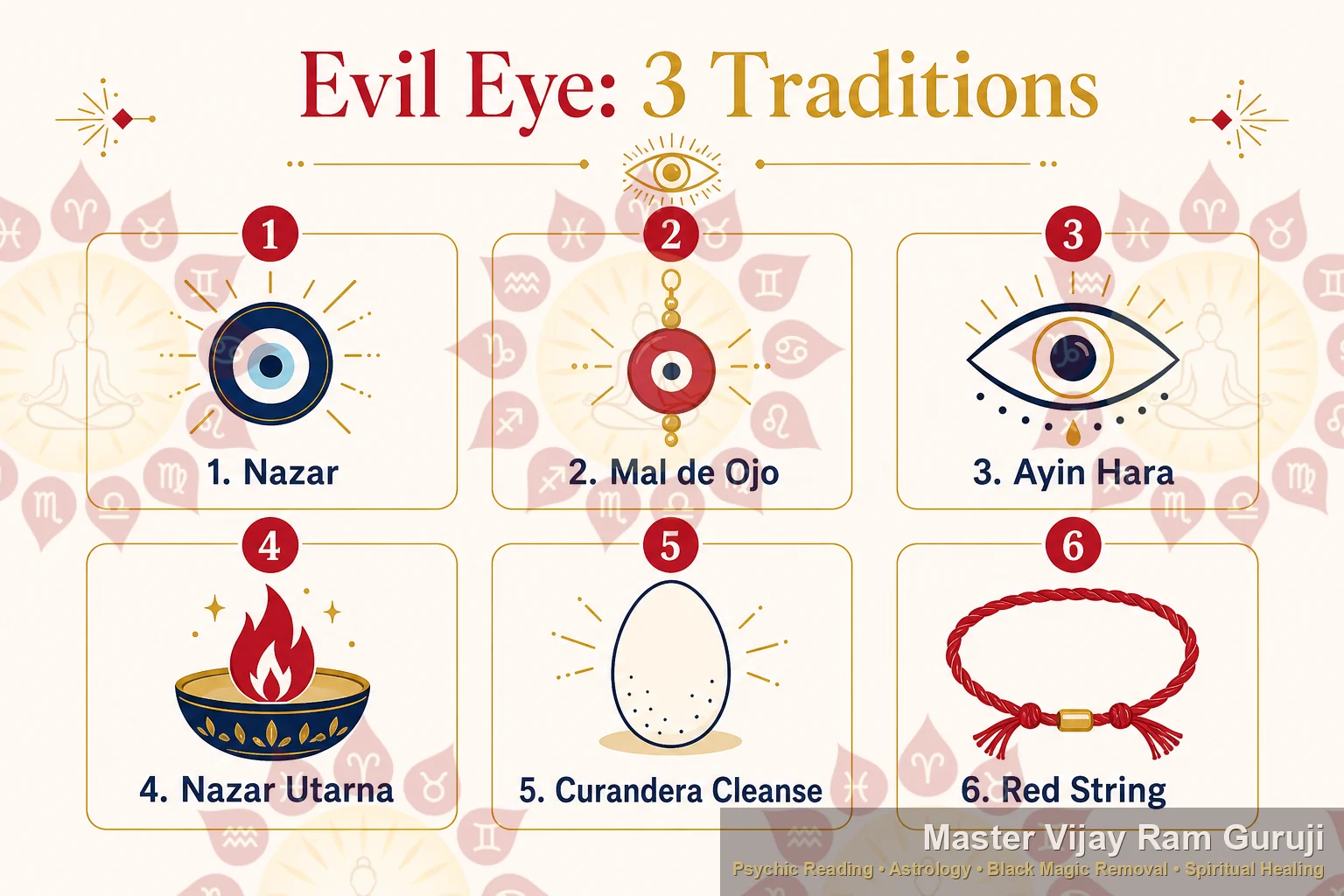
The evil eye is a cross-cultural belief that an envious or intense gaze can transfer negative energy to a person, causing harm. Known as nazar in South Asian and Turkish traditions, mal de ojo in Latin cultures, and ayin hara in Jewish practice, all three share common symptoms and protective rituals.
The evil eye is a cross-cultural spiritual concept — a belief, found across dozens of societies, that a gaze charged with envy, admiration, or ill-will can involuntarily transfer harmful energy to another person. From the dusty bazaars of Anatolia to the festive households of South Asia and the synagogues of Eastern Europe, this idea has persisted for millennia under different names, different rituals, and different protective symbols. Families in Scarborough and across the Greater Toronto Area bring these living traditions with them, and understanding the parallels between them can be the first step toward finding genuine relief.
What Is the Evil Eye, Exactly?
At its core, the evil eye describes an invisible force set in motion by a gaze — most often one of envy or intense focus — that disrupts the energy field of the person it lands on. The disruption is rarely considered intentional; many traditions emphasise that even a well-meaning look of admiration from a stranger can cause harm if unguarded. The concept is so widespread that anthropologists consider it one of the most consistent folk beliefs across human civilisation.
What distinguishes the evil eye from ordinary misfortune is a pattern: sudden onset of symptoms after being praised or admired, symptoms that do not respond to conventional explanations, and relief that follows a traditional cleansing ritual rather than medication. If you recognise this pattern, speaking with a practitioner who assesses and addresses nazar in the Scarborough area may provide clarity.
Nazar: The South Asian and Turkish Tradition
Nazar (from the Arabic and Urdu word for "gaze") is the name given to the evil eye in South Asian, Turkish, Persian, and Arab communities. In these traditions, nazar is considered a real energetic transmission — almost like an accidental curse — that a person of strong emotion can unknowingly project. Infants, newly-weds, and those who have recently received good fortune are considered especially susceptible.
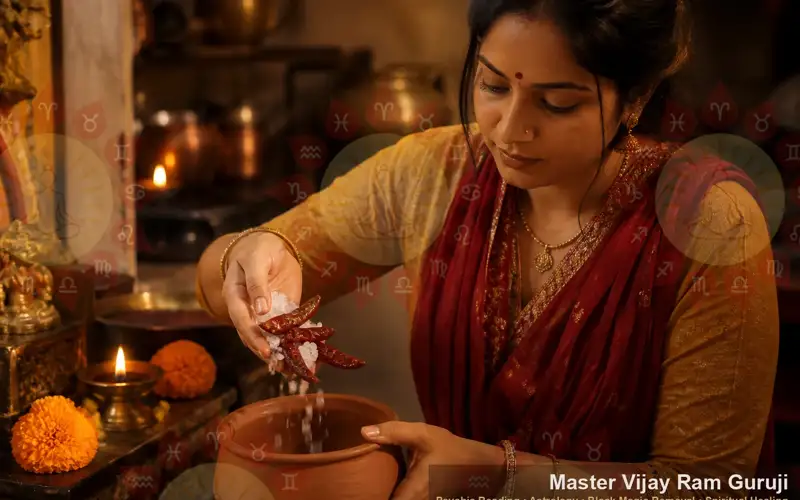
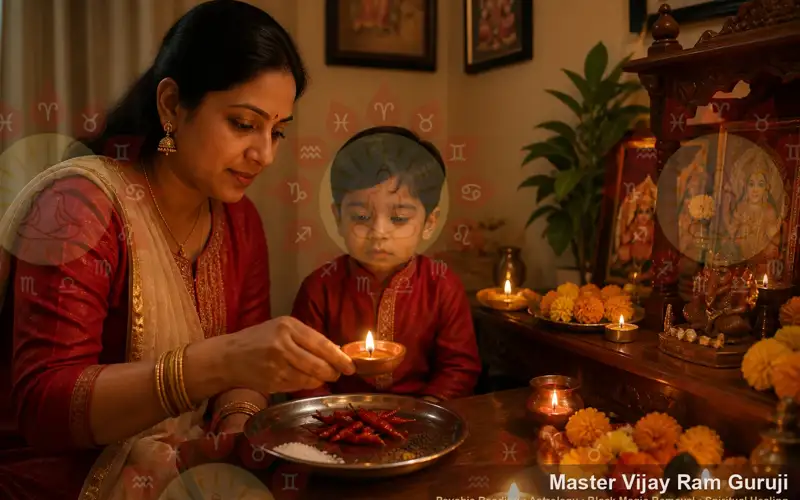
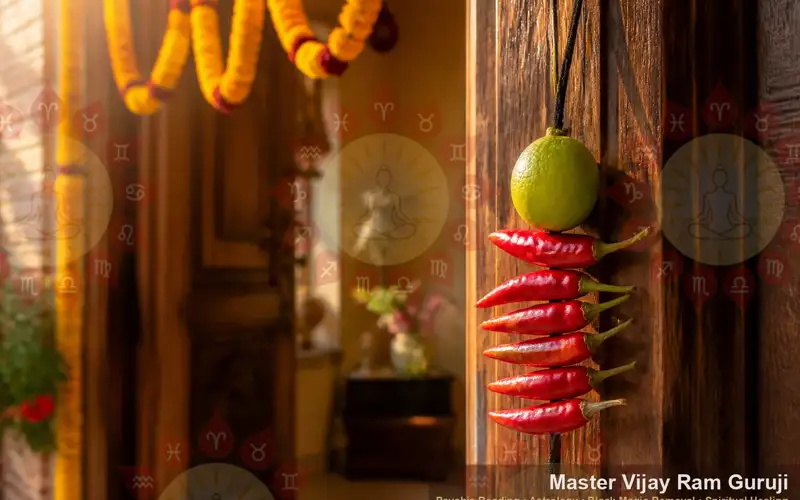
The ritual most commonly used to diagnose and lift nazar is nazar utarna, which typically involves circling a lit camphor flame, mustard seeds, or dried red chillies around the affected person and then burning or discarding them outside the home. The flame or salt is believed to absorb and neutralise the transferred energy. In many South Asian households, this is performed weekly as prevention, not only when symptoms appear.
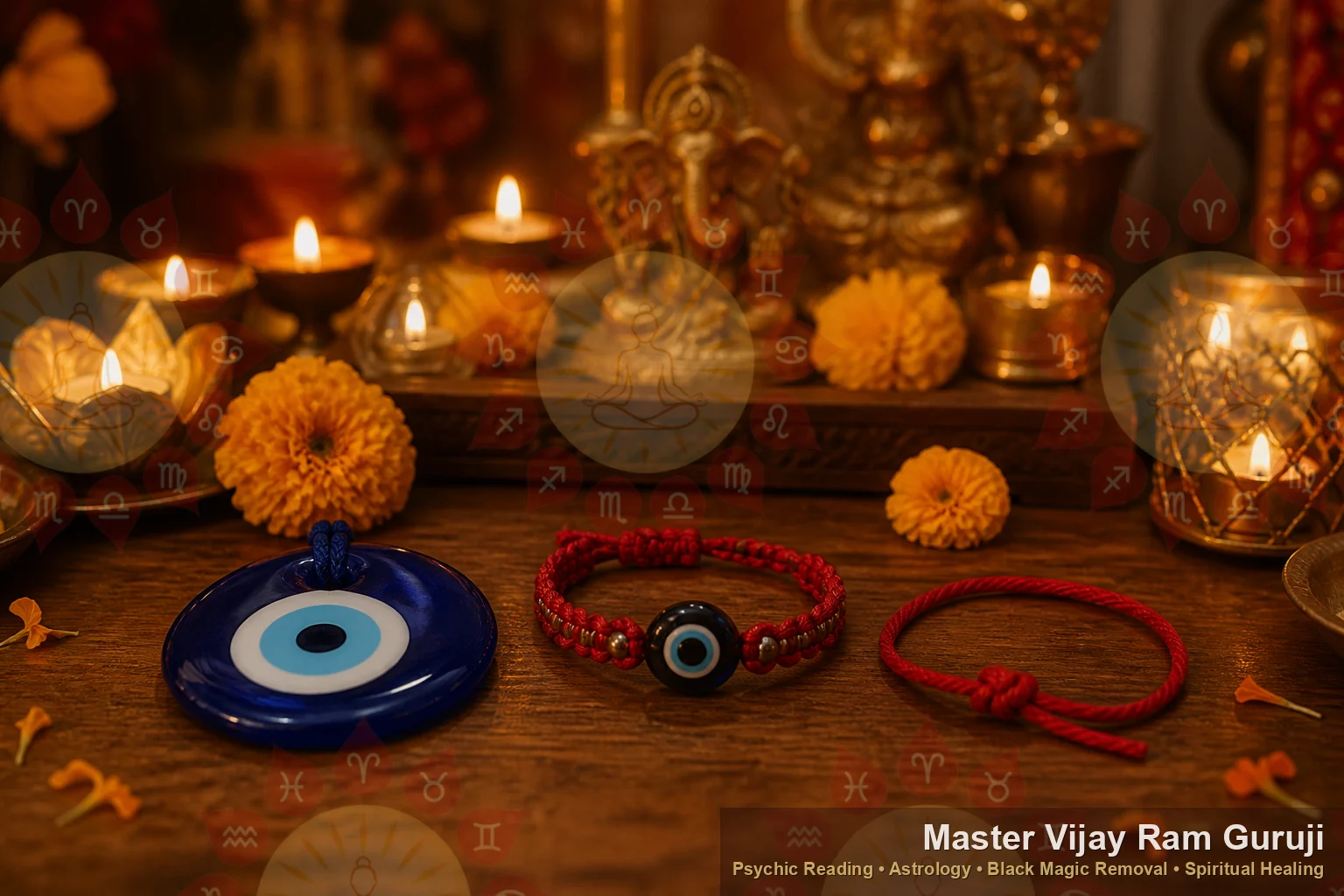
- Common protective objects: blue glass nazar boncuk amulet, kala teeka (black dot on an infant's forehead), black thread tied at the wrist
- Typical ritual duration: a single nazar utarna session takes 15–30 minutes; a deeper cleansing havan may span 90 minutes to several hours
- Who performs it: experienced elders in the family, or a trained Vedic healer or spiritual practitioner
Mal de Ojo: The Latin American and Mediterranean Tradition
Mal de ojo — Spanish for "evil of the eye" — is the dominant term in Latin American, Spanish, Portuguese, and parts of Italian and Greek folk belief. The tradition holds that an admiring or envious gaze, particularly directed at a child, can cause fever, crying, vomiting, or listlessness. Historically, the cure was administered by a curandera (healer), most often through a limpia (cleansing) involving a raw egg.
In the egg limpia ritual, the healer passes a whole raw egg over the body of the affected person, praying or reciting specific words. The egg is then cracked into a glass of water and "read" for signs — a cloudy yolk, bubbles, or a shape resembling an eye all indicate that mal de ojo was present and has been absorbed into the egg. The egg is then discarded, ideally buried or flushed away.
While the ritual differs from South Asian nazar utarna, the underlying logic is structurally identical: a physical object absorbs the harmful energy and is then removed from the person's environment. Both traditions treat the cause as energetic, not germ-based, and both recommend protective measures after cleansing. For those in Scarborough, Markham, or the broader Greater Toronto Area who carry this tradition, working with a practitioner who understands cross-cultural spiritual healing can bridge the gap between your home tradition and accessible local support.
Ayin Hara: The Jewish Kabbalistic Tradition
Ayin hara (Hebrew: עַיִן הָרָע, literally "evil eye") appears throughout the Talmud, Midrash, and kabbalistic literature. In Jewish tradition, ayin hara is not merely folk superstition — it is discussed by major rabbinic authorities as a real spiritual force that can diminish a person's divine protection when they attract excessive attention or jealousy. Public boasting, displaying wealth, or counting possessions are considered ways to invite ayin hara.
The most widely known modern protective measure is the red string tied around the left wrist, popularised through Kabbalah practice and associated with the tomb of Rachel in Bethlehem. Recitation of specific Psalms — particularly Psalm 91 — and the use of the hamsa (a palm-shaped amulet) are also common. Spitting three times ("ptoo ptoo ptoo") after giving a compliment is a traditional verbal deflector across both Sephardic and Ashkenazi communities.
Signs of the Evil Eye: A Cross-Cultural Checklist
Despite geographical and cultural distance, the reported symptoms of nazar, mal de ojo, and ayin hara overlap considerably. Across traditions, the following signs are consistently described:
- Sudden, unexplained fatigue or weakness — especially after being complimented or praised
- Persistent headache or heaviness in the head that does not respond to rest
- Unexplained crying, irritability, or fever in infants and young children
- A run of unrelated setbacks — financial, relational, and professional — appearing simultaneously
- Restless sleep, vivid bad dreams, or waking feeling more tired than before sleeping
- Loss of appetite or nausea without a clear medical cause
- A general sense that "something is wrong" that the person cannot articulate
Important note: these symptoms can also have straightforward medical causes. Always consult a qualified healthcare provider to rule out physical illness. Spiritual assessment addresses the energetic dimension and does not replace medical care.
How Do the Three Traditions Compare?
| Tradition | Name | Primary Cleansing Ritual | Key Protective Object |
|---|---|---|---|
| South Asian / Turkish | Nazar | Nazar utarna (camphor / chilli flame) | Blue nazar amulet, black thread |
| Latin American / Mediterranean | Mal de ojo | Egg limpia by a curandera | Red mal de ojo bead bracelet |
| Jewish / Kabbalistic | Ayin hara | Psalm recitation, red-string tying | Hamsa, red string (Kabbalah) |
Can a Vedic Practitioner Help With Non-South-Asian Traditions?
The energetic principles underlying all three traditions are remarkably consistent: an external source of negative energy disrupts a person's protective field, and structured ritual removes that disruption. A practitioner experienced in Vedic spiritual healing understands this framework at a deep level and can apply it regardless of which cultural tradition a client comes from. Master Vijay Ram Guruji consults with families from across the Greater Toronto Area — from South Asian households in Scarborough and Markham to Latin American families in Vaughan and Ajax — and works within the energetic logic each tradition shares.
Protective tools such as a personalised kavach or taweez prepared for energetic protection function on the same principle as a hamsa or a mal de ojo bracelet: they create a buffer in the person's energy field that deflects harmful transmissions before they can settle. For deeper energetic disruption, a structured aura cleansing session that works through accumulated negative impressions may be recommended alongside protective measures.
What Happens During a Consultation in Scarborough?
At 1540 Warden Ave., Scarborough, ON M1R 2S8, Master Vijay Ram Guruji begins with a conversation about the pattern of events and symptoms the client has noticed, often combined with an assessment of the birth chart to identify planetary vulnerabilities. This informs whether the issue is best addressed through a targeted nazar-removal ritual, a broader treatment that removes accumulated negative energy from the home and personal field, or a combination of both. Consultations are available in English, Tamil, Hindi, Punjabi, Gujarati, and Urdu — in person or remotely by phone, video, or WhatsApp, 24 hours a day.
If you are uncertain whether what you are experiencing is related to the evil eye, the most useful first step is simply to reach out to book an initial assessment and describe the pattern of symptoms. There is no obligation, and clarity itself is often a relief.
Frequently asked questions
What is the difference between nazar and mal de ojo?
Both refer to harm caused by an envious or admiring gaze, but nazar is the term used in South Asian, Turkish, and Arab traditions, while mal de ojo is the Spanish-language equivalent from Latin American and Mediterranean cultures. The cleansing rituals differ — camphor flames for nazar, egg limpia for mal de ojo — but the underlying belief is nearly identical.
What does ayin hara mean in Jewish tradition?
Ayin hara is Hebrew for 'evil eye.' In Jewish kabbalistic and Talmudic teaching, it describes a spiritual force activated by excessive envy or public attention that weakens a person's divine protection. Common remedies include reciting Psalm 91, tying a red string around the left wrist, and using a hamsa amulet.
Is the evil eye belief found in all religions?
References to the evil eye appear in Islam (as al-ayn, mentioned in hadith), Judaism (ayin hara in the Talmud), Hinduism (nazar, addressed in Vedic texts), and in folk Catholic practice (mal de ojo). It also appears in ancient Greek and Roman writings, making it one of the most cross-religious spiritual concepts on record.
Can infants and children be affected by the evil eye?
Yes — across all three major traditions (nazar, mal de ojo, and ayin hara), infants and young children are considered the most vulnerable, because they lack the energetic boundaries that develop with age. Symptoms attributed to the evil eye in children include unexplained crying, fever, loss of appetite, and restlessness. Always have a doctor rule out medical causes first.
How long does it take for nazar removal to work?
A single nazar utarna ritual — using camphor, mustard seeds, or dried red chillies — typically takes 15 to 30 minutes. How anyone responds varies, and no result is promised. For persistent or recurring nazar, a series of sessions or a deeper havan ritual over one to three days may be recommended by the practitioner.
Does Master Vijay Ram Guruji serve clients outside Scarborough?
Yes. While the consultation centre is at 1540 Warden Ave., Scarborough, remote consultations are available 24 hours a day by phone, video call, and WhatsApp, making Master Vijay Ram Guruji accessible to clients across the Greater Toronto Area — including Markham, Pickering, Vaughan, Richmond Hill, Ajax, and North York.
Are evil eye protective amulets like the hamsa or nazar boncuk effective?
Within their respective traditions, protective amulets are considered a first line of defence — they are believed to absorb or deflect the harmful gaze before it reaches the wearer. A practitioner may recommend a tailored protective kavach or taweez as a complement to a formal cleansing ritual for stronger or recurring cases.
Is spiritual evil eye treatment a substitute for medical care?
No. Spiritual assessment and ritual address the energetic dimension of a person's experience and do not replace diagnosis or treatment by a qualified medical professional. If symptoms such as fever, fatigue, or persistent headache are present, please consult a doctor. Both approaches can coexist — they address different dimensions of well-being.
People also ask
Which cultures believe in the evil eye?
The evil eye belief is documented in South Asian, Turkish, Arab, Persian, Latin American, Greek, Italian, Jewish, and West African cultures, among many others. Anthropologists estimate it appears in recognisable form in over 40 distinct cultural traditions worldwide, making it one of the most universal folk beliefs in human history.
What is the evil eye called in different languages?
In Arabic and Urdu it is nazar or al-ayn; in Hebrew, ayin hara; in Spanish, mal de ojo; in Turkish, nazar boncuk (also the name of the glass amulet); in Italian, malocchio; in Greek, matiasma; and in Hindi/Punjabi, nazar laagna. Despite different names, all describe the same concept of a harmful gaze.
What are the most common symptoms of the evil eye?
Across cultures, reported symptoms include sudden fatigue, unexplained headaches, a run of bad luck, disturbed sleep, loss of appetite, and — especially in children — unexplained crying and low-grade fever. Symptoms typically appear shortly after the affected person was praised, admired, or shown off publicly.
How do you protect yourself from the evil eye?
Protective measures vary by tradition: blue nazar amulets and black threads in South Asian practice; red mal de ojo beaded bracelets in Latin culture; hamsa and red strings in Jewish Kabbalah. A trained spiritual practitioner can also prepare a personalised kavach or taweez for ongoing energetic protection.
Can the evil eye be transmitted unintentionally?
Yes — all three major traditions (nazar, mal de ojo, and ayin hara) explicitly acknowledge that the harmful gaze is usually involuntary. A well-meaning compliment from someone with strong emotions is considered capable of transmitting evil-eye energy, which is why protective rituals are used proactively, not only after harm has occurred.
References & further reading
Keep exploring
Serving Scarborough and the Greater Toronto Area
In person at 1540 Warden Ave., or by phone, video & WhatsApp — including: